Method overview
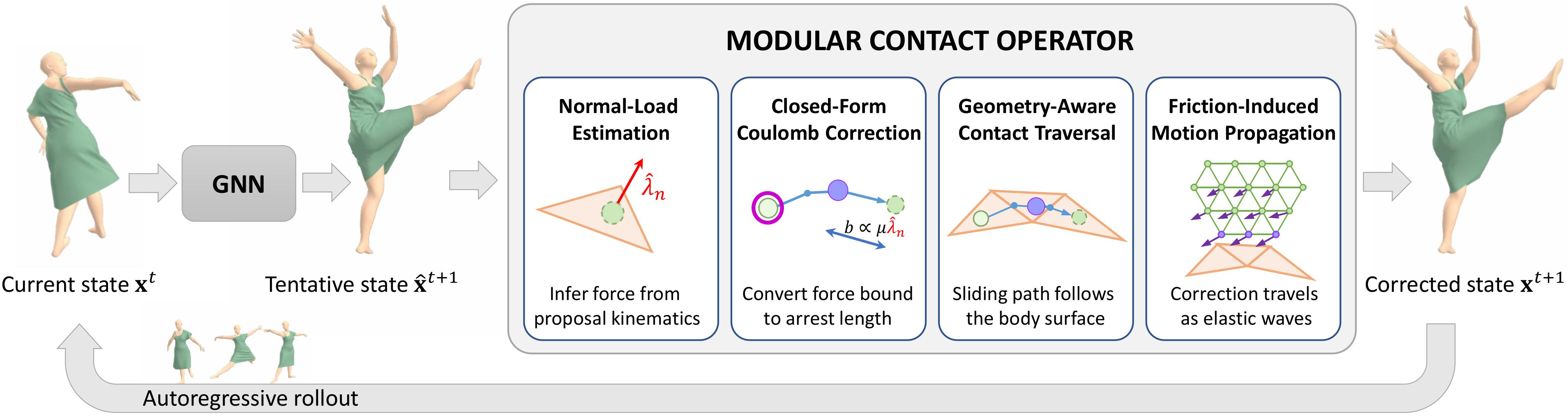
Graph neural networks (GNNs) simulate garments efficiently through physics-based self-supervision, but leave body–garment friction implicit or inside training energies, with no friction coefficient μ to set at inference; retraining the tested GNNs with a coefficient-specific friction term barely responds to μ. Optimization-based solvers decide each contact's stick–slip state from the reaction that governs it, but only by re-optimizing the garment state at every step; a friction term in a one-pass training objective acts as a fixed-weight penalty on sliding, and the trained weights apply no per-contact Coulomb condition at inference. We therefore resolve friction explicitly after prediction: a Modular Contact Operator, attached to a frozen predictor without retraining or an iterative solve, estimates the normal load, applies a closed-form Coulomb correction along a path across body triangles, and propagates the induced motion through the cloth as a linearized membrane wave. On HOOD and ContourCraft, it raises sticking and lowers slip monotonically in μ, tracking a reference solver's response while coefficient-specific retraining stays flat, with low penetration and reference-consistent stretching at an eighth of the solver's runtime.
ContourCraft backbone · tank · AMASS CMU motion: 05_06
HOOD backbone · long sleeve · AMASS CMU motion: 143_27
ContourCraft backbone · dress · AMASS CMU motion: 05_06 · μ = 0.3
ContourCraft backbone · long sleeve · AMASS CMU motion: 05_06 · μ = 0.6
ContourCraft backbone + our operator throughout — the same frozen network, the same motion, two nearby coefficients. Click a card to pause it.
dress · AMASS CMU motion: 07_02
longsleeve · AMASS CMU motion: 136_12
tshirt · AMASS CMU motion: 133_02
longsleeve · AMASS CMU motion: 127_02
@inproceedings{truong2027explicit,
  title         = {Explicit Frictional Contact Modeling in Neural Garment Simulation},
  author        = {Truong, Thanh-Nguyen and Tran, Vu-Hoang and Huang, Ching-Chun},
  booktitle     = {Proceedings of the IEEE/CVF Winter Conference on
                   Applications of Computer Vision (WACV)},
  year          = {2027},
  eprint        = {2610.33492},
  archivePrefix = {arXiv},
  primaryClass  = {cs.CV}
}